
Invisible to AI? Why Reviews Now Decide Which Stays Get Recommended
Travelers ask ChatGPT, Gemini and Perplexity where to stay and get a shortlist of three to five names. Here is how AI builds that shortlist, what it reads about your property, and how your reviews get you on it.

Your next guest won't search. They'll ask.
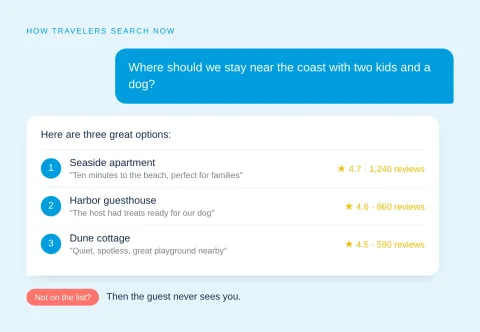
A traveler types "Where should we stay near the coast with two kids and a dog?" into ChatGPT. Instead of ten pages of links, they get three to five names. If your property isn't one of them, you're not second choice. You're invisible.
This is actually a very old rule. In 1900, two French tire makers published a free guide telling drivers where to eat and sleep, so they would drive more and wear out more tires. Its highest praise became worth a special journey. The brothers' names? André and Édouard Michelin.
The rule has held for 125 years: get recommended by someone independent, or don't get chosen. What has changed is who writes the guide, how you get into it, and how fast it moves.
The guide has a new author
A shortlist, not a page of links
Today a family asks ChatGPT, Gemini or Perplexity where to stay in Gothenburg with two kids. Instead of ten blue links, they get one confident shortlist of three to five names.
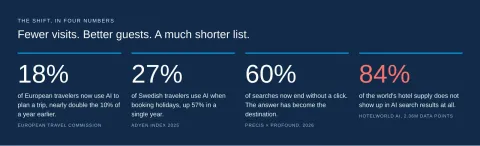
Two years ago that was a novelty. Now it is mainstream. 56% of US travelers used AI for at least one trip in the past year, up from 43%. In Europe, AI use in trip planning nearly doubled in a single year.
The growth is fastest in the markets that fill Europe's rentals and hotels: Germany, the UK, the US and the Netherlands. When a family in Hamburg asks, in German, where to stay by the coast, the answer is being assembled right now, from data most hosts have never actively managed.
The traffic is smaller. Each visit is worth more.
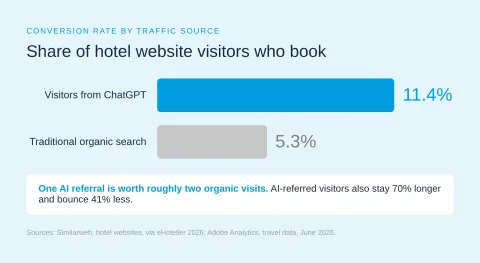
AI referrals are still a small slice of the pie, but look at who arrives. Visitors coming from ChatGPT book at roughly twice the rate of traditional organic search, and they stay longer on the site.
That is the behavior of someone who has already researched, compared and narrowed the field. They are not browsing. They came to check the details and book, so your booking engine had better be ready for them.
Nobody fully trusts AI yet. It changes nothing.
Fair point, and a real one. Expedia's research found that while 39% of travelers use AI to research trips, only 8% rely on a chatbot as their main planning tool, and 68% still prefer to book with brands they trust. About a third report getting incorrect or incomplete answers.
But watch what travelers do with that doubt. They take the AI shortlist and verify it: they read the reviews, open the website, compare on an OTA. Verification doesn't undo the shortlist. It confirms it. Your photos, your listing and your rate only get their turn if you made the cut.
You don't have to win the whole journey in AI. You have to survive the first cut.
What this means for your data
AI reads about you elsewhere
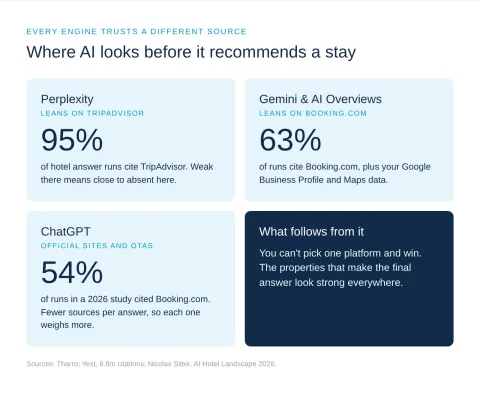
Here is the uncomfortable part. AI builds its picture of your property mostly from sources you don't own. Around 85% of what AI knows about a brand comes from third-party pages, and in one study of unbranded hotel searches, the hotel's own website made up less than 10% of the citations.
Ranking well on Google doesn't save you either: 56% of the hotels AI recommends never appear in Google's top organic results.
Your website still matters, as the place AI checks facts and guests finally land. But whether you get recommended at all is decided on Google, TripAdvisor, Booking.com and Airbnb, in reviews you cannot write yourself. Which is exactly why AI trusts them.
Your ratings and reviews are no longer a customer service topic.
They are your primary marketing infrastructure in the age of AI search.
Reviews are the evidence AI reads
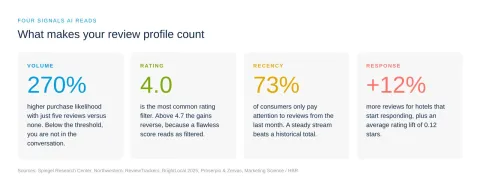
AI assistants are cautious by design. They recommend what they can back up with evidence, and in travel the richest, most machine-readable evidence that a place is good is its review profile. Four signals do most of the work:
Why 2,000 reviews beat a perfect score
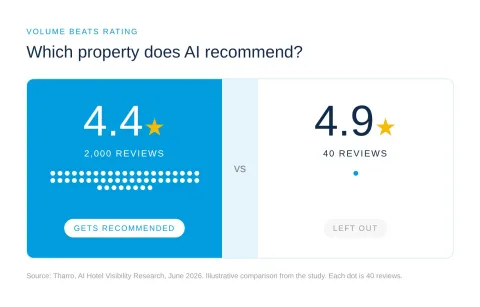
In Tharro's analysis of AI hotel recommendations, review volume and star class predicted who got named better than guest rating did. Their own illustration: a 4.4 with 2,000 reviews beats a 4.9 with 40.
For a broad question like "best places to stay in this region", AI isn't checking whether evidence exists. It is comparing how much confident, specific, quotable material it has on each candidate.
Good news for smaller properties: you can't manufacture a 4.9, but you can ask every guest. And detail counts. "Ten minutes from the harbor" or "the host switched effortlessly to German" gives AI something to quote. "Great stay" does not.

Your guests write in German. So does the AI.
Guests from the big European source markets are keen reviewers: 70% in the UK, 64% in France, 60% in Germany. They ask AI for recommendations in the same language they review in. A profile rich in German reviews is exactly the evidence AI needs to answer a German traveler's question, and replying in the guest's language strengthens the signal further.
"When rates and locations are similar, reviews decide it."
Sergio Pancadas, General Manager, Adventure Hotels, South Iceland
For Adventure Hotels, a strong rating pays three ways at once: it helps hold the rate, lifts visibility on the OTAs, and builds trust before a guest even arrives.
Three moves you can make this quarter
None of this needs a new budget to start. It needs an owner and a routine.
1. Respond, and check your coverage
Reply to every review, the good ones too, within 24 to 48 hours and in the guest's language. The most visible brands answer 80.5% of their reviews in about 2.1 days. Every reply is fresh, indexed text attached to your profile: a line about your new hot tub is marketing copy placed exactly where the machines are reading.
2. Pick the fight you can win
A ten-unit host won't out-review a big chain on "best place to stay in the city". You can own something narrower and honest, like "quiet apartment near the ferry with kids". In Sweden, ICEHOTEL has only 5.5% share of voice in AI answers across the whole travel sector, yet it is the number one answer for winter-activity queries. Depth in one niche beats breadth across many.
3. Reinforce the language
Once you know your niche, ask for it. Invite happy dog owners to say what they loved, and you get "the host had treats ready for Bruno at check-in" instead of "great stay". Then echo it back in your reply: "So glad Bruno enjoyed his treat." Small, specific, recent. Exactly the kind of sentence AI can lift.

Make the ask part of the experience
In Tromsø, Best Arctic saw organic visibility drop as guests moved their research into chat windows. Their response was practical: a named colleague now owns replying to every review, patterns go to a weekly meeting, and guests get a QR code at the right moment, when they are relaxed and the tour has just ended.
"You don't control what people are saying, but you can control the effort you make to ask for that feedback."
Carolina Pena, Marketing & Brand Manager, Best Arctic
One firm rule: never fake or buy reviews. Platforms detect it, penalties are severe, and one exposed fake undoes the trust a hundred real reviews built.
Photo © Best Arctic
Where VISIT Reputation fits
Beds24 is part of VISIT, and VISIT Reputation, powered by Olery, is built for exactly this job. Your reputation now lives across dozens of platforms, in many languages, read by machines around the clock. VISIT Reputation gives you the overview you are missing.
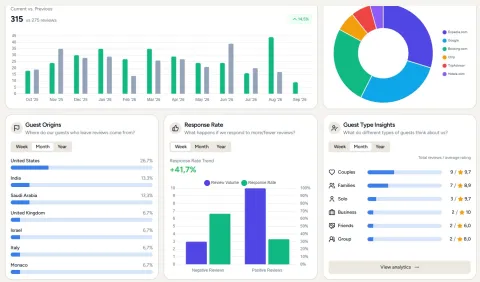
See yourself the way AI sees you
See which platform is starving for reviews, how your rating trends on a rolling basis, where your response rate slips and which guest types love you most. Then act on it from the same place.
-
4.1 billion reviews across some 8 million properties, aggregated daily from 60+ platforms including Google, TripAdvisor, Booking.com and the major experience marketplaces.
-
Sentiment analysis in all languages, in the original language, with topic-level insight that shows not just that a rating moved, but why.
-
Response workflows and direct reply integrations to the key review channels, so replying to 100% of reviews becomes a routine rather than a project.
How visible are you today?
We will show you what the three big AI engines say about your property, and how your review profile compares with the competitors that matter to you.
Want to dig deeper? Read our guides on reviews and online reputation management and how to create a positive memory.
Sources: VISIT, Invisible to AI, industry report, 2026; HotelWorld AI, World's Best at AI Index, June 2026; Tharro, AI Hotel Visibility Research, June 2026; Yext, AI citation study, 2025; Nicolas Sitter, AI Hotel Landscape 2026; Phocuswright, Travel Forward 2026; Expedia Group, The AI Trust Gap, 2026; Adobe Analytics, June 2026; Similarweb via eHotelier, 2026; European Travel Commission, 2025; Adyen Index 2025; Precis and Profound, AI Search and the Swedish Travel Sector, May 2026; Spiegel Research Center, Northwestern University, 2017; ReviewTrackers, 2022; BrightLocal, 2025; Proserpio and Zervas, Marketing Science and HBR, 2017 to 2018; SOCi, Local Visibility Index. Most studies show correlation rather than proven cause and effect.